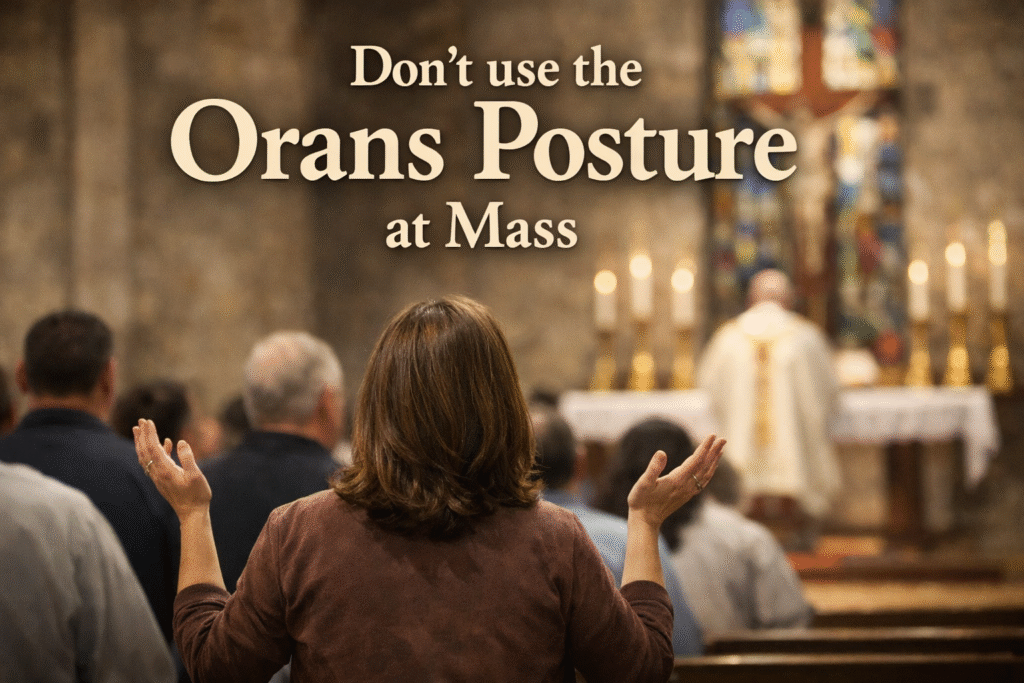
Don’t use the Orans posture at Mass
There are moments when a small gesture reveals a large misunderstanding.
The Orans posture, when assumed by the congregation during the Our Father, is usually adopted with good intention. It is meant to feel prayerful, expressive, even unifying. Rarely is it an act of defiance.
But sincerity, admirable as it is, does not determine truth.
The liturgy is not composed of gestures chosen for how they feel, but of actions that mean something before they feel like anything. To misunderstand a gesture is to misunderstand the reality it expresses.
Gesture Is Theology Made Visible
The Church has always known that the body teaches the soul. Before doctrine is explained, it is enacted. How one stands, kneels, bows, and prays forms belief as surely as words do.
The Orans posture is not simply a general posture of prayer. It is the posture of one who offers prayer on behalf of others. It is the stance of mediation and intercession.
In Scripture and tradition, it belongs to the priest.
When the priest extends his hands at the altar, he does so not as a private individual expressing devotion, but as one who acts in the person of Christ, addressing the Father for the people entrusted to him. This distinction is not clericalism. It is sacramental realism.
The Priest Is Not Merely One Among Many
Modern sensibility is uneasy with difference of role. It prefers sameness of expression to hierarchy of function. But the Church is not governed by sentiment. She is governed by sacrament.
The priest presides not because he is more expressive, but because Christ acts through him in a way that does not occur through the congregation. His gestures are therefore not interchangeable with those of the faithful.
When the congregation adopts the priestly posture, the unique role of mediation is quietly blurred. And what the body practices, the mind eventually believes.
The Our Father and Proper Order
The Our Father is indeed the prayer of the children of God. But it is offered within the priest’s presidential prayer. The priest gathers the intentions of the faithful and addresses the Father in their name.
The people pray not as presiders, but as sons and daughters who are being represented. There is no loss of dignity here. Sonship does not require imitation of authority. It requires trust.
Unity Is Not Sameness
Unity does not arise from identical gestures, but from harmony of roles. A symphony is unified not because every instrument plays the same note, but because each fulfills its proper function.
The liturgy works the same way.
When priest and people each assume the posture proper to them, the Church appears as she truly is: one body, many members, ordered toward God.
Sameness produces confusion. Order produces peace.
Feeling Prayerful Is Not the Measure of Worship
It is often said that the Orans posture helps people feel more prayerful. But the liturgy is not ordered toward feelings. It is ordered toward truth.
The Mass is not the place where we decide how best to pray, but where we consent to pray as the Church has received prayer. The liturgy is inherited, not improvised.
To submit to that inheritance is not repression. It is humility.
Reverent Restraint
The Church does not need more gestures. She needs gestures to mean what they are meant to mean.
The faithful need not raise their hands to pray deeply. They need to stand attentively, kneel reverently, and receive humbly.
The Orans posture is not wrong because it is expressive.
It is misplaced because it is priestly.
And when each member of the Church prays according to the role Christ has given, the liturgy becomes what it was always meant to be:
Not an expression of ourselves,
but an entry into something infinitely greater.