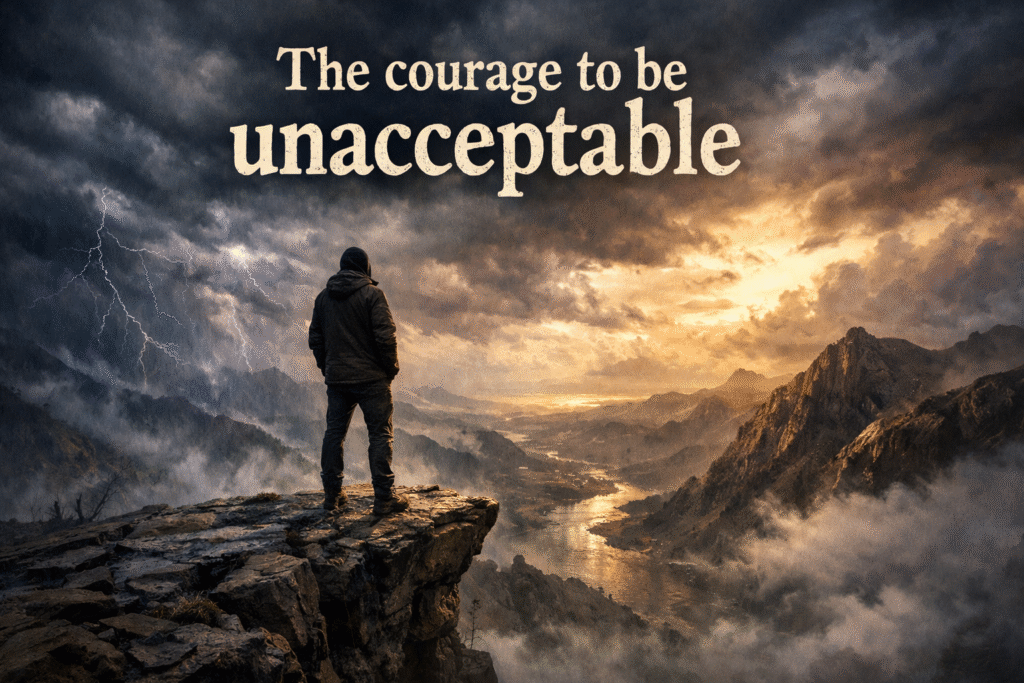
The courage to be unacceptable
Every age has its fashionable virtues and its tolerated crimes. What distinguishes a declining civilization from a rising one is not whether it sins, but whether it still knows how to blush. America today has ceased to blush. It applauds what should horrify it, excuses what should shame it, and ridicules those who still dare to call sin by its name.
The Catholic in such an age must understand one thing clearly: normality is no longer a measure of truth. What is widely accepted may be widely wrong. What is legally protected may be morally indefensible. And what is socially celebrated may be spiritually catastrophic.
To be Catholic in America today is to defy the consensus.
We are told that abortion is compassion, yet it dismembers the most defenseless human life imaginable. We are told it is “choice,” yet the only one who does not choose—the child—is erased from the moral equation. We are told it is freedom, yet it enslaves women to despair, men to cowardice, and the nation to a culture of death. No society that calls killing a right can long defend any other right with coherence.
We are told that sexual license is liberation, that marriage is a social construct, that children need no mother or father—only desire and affirmation. Yet we watch families fracture, children grow confused and wounded, and loneliness reach epidemic proportions. A nation that rejects the natural law will inevitably be ruled by unnatural confusion.
We are told that politics is merely strategy, that character is secondary, that “our side” must be defended at all costs. Thus we excuse corrupt politicians, habitual liars, warmongers, profiteers, and demagogues—so long as they promise us comfort or victory. Catholics are pressured to baptize immorality with party loyalty. But the Church does not exist to sanctify political power. She exists to judge it.
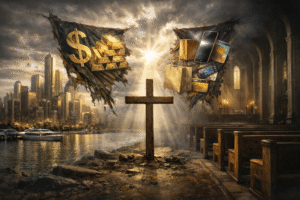
We are told that economic systems are neutral, that markets absolve conscience, that exploitation is regrettable but unavoidable. Meanwhile, families drown in debt, workers are treated as disposable machinery, the poor are blamed for their poverty, and wealth concentrates into fewer and fewer hands. Charity is praised loudly, while justice is postponed indefinitely. But Scripture never allowed a society to grow rich by crushing the poor and still call itself righteous.
We are told that war is sometimes necessary—but no longer mourned. Violence is normalized through entertainment, speech is cheapened into rage, and human beings become abstractions to be managed rather than neighbors to be loved. We speak of peace while manufacturing instruments of destruction with religious devotion.
We are told that religion must remain private—silent in the public square, invisible in law, and absent from moral discourse. Faith may comfort the individual, but it must never challenge the collective conscience. In other words, God may exist—but He must not rule.
And so the Catholic who resists these lies is labeled intolerant, backward, extreme, or dangerous. He is told to adapt, evolve, compromise, or disappear. But the Cross itself was once called extreme. The martyrs were once accused of disturbing the peace. And every prophet in history was told he would be more effective if he were quieter.
The world does not persecute Catholics for being kind.
It persecutes them for being right.
The modern American is trained to fear exclusion more than error. He will surrender eternal truths to avoid temporary discomfort. He will kneel to public opinion because it offers immediate rewards. But Catholicism was never meant to be comfortable—it was meant to be true.
To protest abortion is to insist that human life is sacred even when inconvenient.
To oppose corrupt leaders is to insist that power does not absolve sin.
To challenge economic injustice is to insist that people matter more than profit.
To defend marriage, family, and moral order is to insist that truth is not malleable.
To refuse silence is to insist that Christ is Lord—not the crowd.
The saints were not successful by worldly standards. They were mocked, exiled, imprisoned, ignored, and killed. Yet they outlasted empires. Because truth does not need applause to endure—it needs witnesses.
America does not need Catholics who blend in.
She needs Catholics who stand apart.
Men and women willing to lose status rather than lose their souls. Willing to be misunderstood rather than unfaithful. Willing to be called unacceptable because they refuse to accept the unacceptable.
For when a society congratulates itself for every sin it commits, the most radical act left is holiness.
And when Catholics recover the courage to defy what everyone else accepts, America may yet remember what it once believed—that freedom without truth is chaos, that rights without responsibility are hollow, and that no nation can survive the rejection of God indefinitely.
Truth has never been popular.
But it has always been victorious.