What Jesus Christ meant by “Follow me”
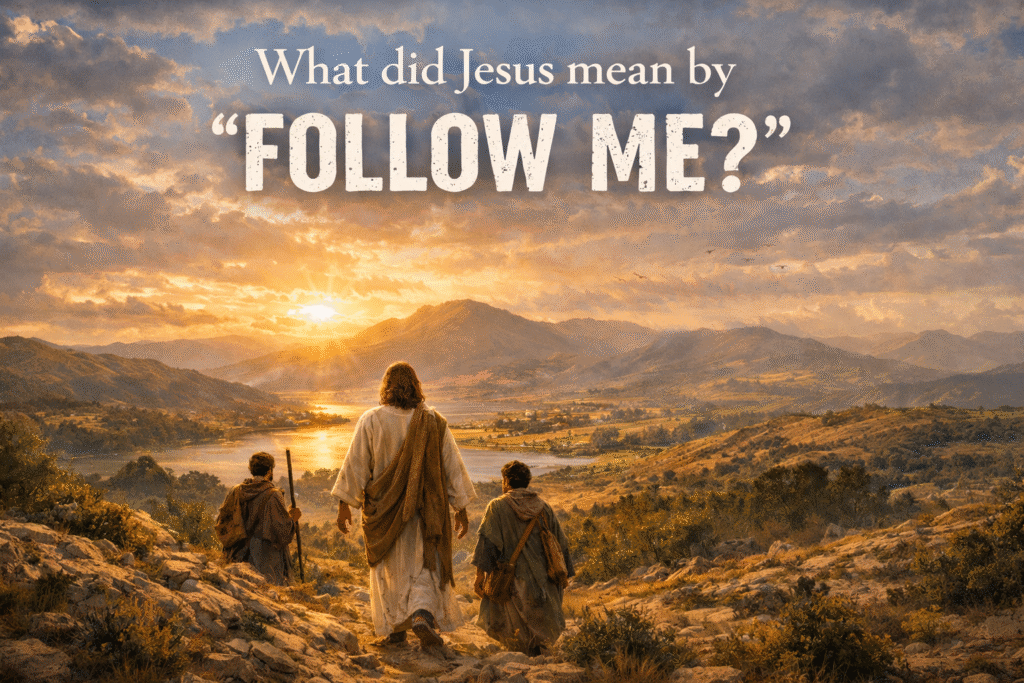
When Jesus said, “Follow me,” He was not offering a metaphor. He was issuing a summons.
Those words were spoken to fishermen with nets in their hands, to a tax collector seated at his table, to a rich man clutching his possessions, and to crowds who sensed that something eternal was standing before them. In every case, the invitation carried the same unspoken demand: your life must change direction.
To follow Christ is not to admire Him from a distance, nor to add His teachings as ornaments to an otherwise unchanged life. It is to accept a new center of gravity, where spiritual goods take precedence over material ones, and eternal truth outweighs immediate advantage.
The Illusion of Neutral Possessions
Modern man insists that possessions are neutral, that wealth and comfort are harmless so long as they are not abused. Christ did not share this optimism. Not because material goods are evil, but because they are powerful.
They bind the heart.
Our Lord did not condemn riches as objects, but as rivals. “You cannot serve God and mammon,” He said, because the heart cannot belong wholly to two masters. The tragedy is not that men possess things, but that things so often possess men.
To follow Christ, therefore, requires a deeper renunciation than is commonly taught. It is not merely the abandonment of excess, but the surrender of dependence. It is not the absence of goods, but the absence of attachment. A man may live in poverty and still worship comfort; another may hold wealth lightly and remain free. The decisive question is always the same: what governs the soul?
Giving Up Everything Without Always Leaving Everything
When Christ told His disciples to leave all and follow Him, He was not establishing a universal economic program. He was revealing a universal spiritual law: no man can walk behind Christ while dragging his old life as an anchor.
Some are called to literal poverty. Others are called to interior detachment. But all are called to the same renunciation of sovereignty. The disciple no longer decides what is ultimate. That decision has already been made.
The modern world recoils from this demand because it confuses freedom with choice. Christ understood freedom as alignment with truth. To follow Him is to relinquish the exhausting burden of self rule and to submit one’s life to a wisdom greater than personal desire.
This surrender is not loss. It is liberation.
The Radicalism the World Cannot Tolerate
The Christian life is radical not because it is extreme, but because it is rooted. It goes to the root of human desire and reorders it. It insists that the soul was made for God, not for accumulation, not for security, not for constant self assertion.
The world tolerates religion so long as it remains decorative. It applauds Christianity when it comforts, inspires, or motivates. It resists it when it commands, judges, or calls for sacrifice.
But Christ did not negotiate with the world. He called men out of it. He asked them to lose their lives in order to find them, to die in order to live, to give in order to receive. These are not poetic contradictions. They are spiritual realities.
The Cross stands at the center of this call, not as an accessory, but as a measure. Any Christianity that promises fulfillment without sacrifice has already ceased to follow Christ.
Spiritual Goods as the True Wealth
Spiritual goods are not imaginary compensations for material deprivation. They are the real currency of eternity.
Truth steadies the mind.
Grace heals the will.
Charity enlarges the heart.
Hope anchors the soul beyond death.
These cannot be purchased, stored, or insured. They must be received, protected, and lived. And they grow only when lesser goods are placed in their proper order.
Christ did not call men away from possessions because He despised the world, but because He understood it too well. He knew how quickly the visible eclipses the invisible, how easily the urgent replaces the important, how subtly comfort dulls the hunger for God.
Following, Not Walking Beside
To follow Christ means to walk behind Him, not alongside Him. The disciple does not set the pace, choose the terrain, or determine the destination. He trusts the One who leads, even when the road narrows, even when the cost becomes clear.
This is the point at which many turn away. Not because Christ asks too much, but because He asks everything. And yet, what He offers in return is not deprivation, but fulfillment. Not diminishment, but wholeness.
For the soul that finally loosens its grip on what it cannot keep discovers something astonishing: it has been given what it could never earn.
To follow Christ is to exchange what passes for what endures, what satisfies briefly for what satisfies eternally, what enslaves for what saves.
And only those who dare to follow Him in this radical sense ever discover that He was not taking life away.
He was giving it back, whole and restored.