Devotion is not God
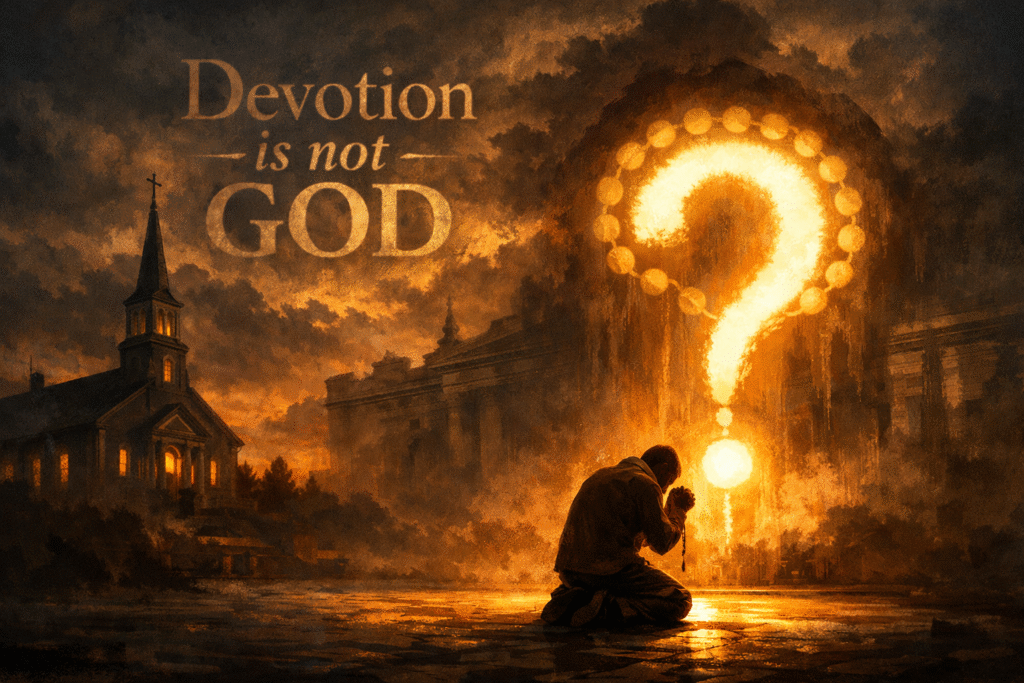
In every age of the Church, God gives His people devotions the Rosary, the Sacred Heart, novenas, scapulars, holy hours not because He needs them, but because we do. They are ladders, not the roof. They are windows, not the sun. Yet one of the quiet tragedies of the spiritual life is that what was meant to lead us to God can slowly take His place.
A devotion becomes dangerous the moment we begin to believe in the power of the devotion itself rather than in the power of God. The beads are not magic. The medal is not a charm. The prayer is not a lever by which we move Heaven. When a soul thinks, “If I just say this prayer enough times, God must do what I want,” religion has slipped from love into superstition. We are no longer children speaking to a Father; we are negotiators trying to manage a transaction. The heart has moved from surrender to control.
This is how devotion, which should free us, becomes a spiritual cage. The person still prays, perhaps more than ever, but anxiety replaces trust. If the novena is not completed perfectly, fear creeps in. If the outcome desired does not come, disappointment hardens into resentment. God is subtly placed in the dock and devotion becomes the evidence used against Him: “I did my part. Why did You not do Yours?” But love does not speak this way. Love says, “Thy will be done,” even when the will of God feels like a cross laid upon the shoulders.
Another way devotion becomes an impediment is when it is aimed entirely at what we want, not at what God wants. Many souls approach prayer as though Heaven were chiefly concerned with rearranging earthly circumstances. Health, success, relationships, protection from suffering these become the constant refrain. There is nothing wrong with bringing our needs before God. A child should ask. But if our devotions never lead us to ask for holiness, detachment, patience, or the grace to suffer well, we have misunderstood the purpose of grace itself. God is less interested in making our lives comfortable than in making our souls beautiful.
Devotions that keep us anchored to this world and its splendor can also obscure the true goal of the spiritual life. Candles, images, music, and rituals can lift the mind to God, but they can also become an end in themselves. A person may grow attached to the feeling of devotion, to the atmosphere, to the consolations, and yet resist the stripping away that prepares a soul for Heaven. Heaven is not built on sentiment; it is built on charity purified through trial. If a devotion never teaches us to lose, to wait, to be misunderstood, to endure dryness, then it has not yet done its deepest work.
The greatest distortion of devotion occurs when we use it to avoid suffering rather than to unite our suffering to Christ. The Cross is not an interruption of the spiritual life; it is its center. Yet many pray chiefly to escape the very trials that could sanctify them. When prayers seem unanswered, they think devotion has failed, when in truth God may be answering at a higher level. He may be giving not the removal of the burden, but the strength to carry it. Devotion should lead us to say, “Lord, if this cup cannot pass, then let me drink it with You.” Anything less leaves the soul still in love with comfort more than with Christ.
True devotion always makes God larger and the self smaller. It loosens our grip on outcomes and tightens our trust in Providence. It lifts the eyes from earth to Heaven, from pleasure to purpose, from ease to eternity. When we come away from prayer more humble, more patient, more ready to forgive, more willing to suffer for love, then devotion has done its holy work.
The test of every devotion is simple. Does it lead me to God’s will, or does it try to bend God to mine? If it teaches surrender, it is from Heaven. If it feeds control, it has become an idol wearing religious clothing. Devotion is a road, not a residence. Blessed is the soul that walks it all the way to Calvary, for only there does every true devotion find its fulfillment in the Heart of God.