Living the Liturgy of Life
The Mystery We Enter
There are two ways of going to Mass. One may go as a spectator goes to a drama, asking whether the music pleased him, whether the sermon held him, and whether the hour passed quickly. Or one may go as a condemned man goes to the place where another has offered to die in his stead. The first looks upon ceremonies. The second enters a mystery.
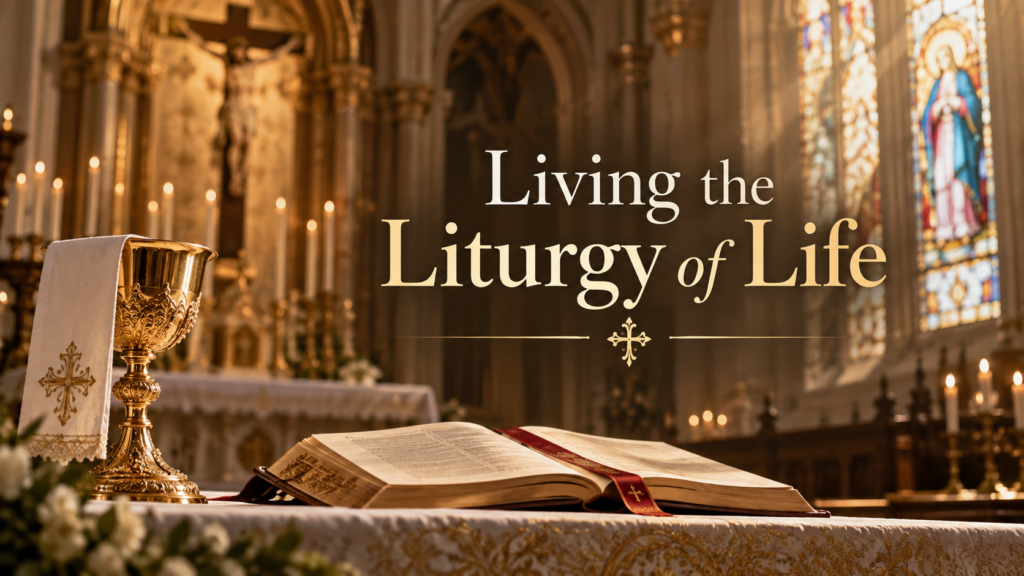
The Mass is not a religious interruption in an otherwise secular week. It is the Paschal Mystery of Christ made sacramentally present: His passage through suffering into glory, through death into life, through apparent defeat into everlasting victory. Calvary is not repeated, for Christ died once for all; yet the one sacrifice of the Cross is made present to us beneath the signs He appointed. The risen Lord gathers His people into His own self-offering to the Father.
We therefore do not come merely to remember that Christ once loved us. We come to be taken into His love now. We bring to the altar the week’s labor, humiliations, temptations, small fidelities, unanswered prayers, and hidden wounds. Bread is brought from the earth and wine from the vine, but with them should come the substance of our lives. If we place nothing of ourselves upon the paten, we should not be surprised if we leave unchanged.
At the consecration, the Church does not invite us to admire sacrifice from a safe distance. She asks us to become sacrificial. At Holy Communion, Christ does not enter us so that we may keep Him imprisoned in private devotion. He gives His Body that we may become His Body; He places His life within us so that His life may appear in our decisions, our spending, our forgiveness, and our service. The final words of the Mass send us forth because communion with Christ necessarily becomes mission. What is received at the altar must be lived in the street.
A Life Governed by Necessity
Our age has multiplied possessions while diminishing peace. It teaches us to call every appetite a need and every inconvenience an injustice. The liturgy teaches another arithmetic. On the altar, Christ holds nothing back. He does not ask how little He may give and still be called loving. He empties Himself.
To live the liturgy, then, is to recover the freedom of necessity: to ask not, “How much may I possess?” but, “What do I truly require in order to fulfill my duties and serve God well?” This is not contempt for created things. Bread, wine, homes, tools, art, and honest recreation are gifts. But a gift becomes a chain when it is possessed without reference to the Giver or the neighbor. The Christian does not measure wealth merely by what is stored, but by what is prevented from flowing toward another.
A life of necessity is not identical for every person. A parent has obligations that a monk does not; a worker may need a vehicle, equipment, or savings that another does not. Prudence must determine the form. But the principle is universal: what lies beyond reasonable need is placed under the judgment of love. We are stewards, not absolute owners. The coat that never leaves the closet, the food that spoils, the money guarded only to enlarge the self – all testify that the offertory has not yet reached the household.
Giving freely does not mean giving carelessly. Christian generosity sees the person, protects dignity, and seeks the true good. Yet prudence must never become a respectable name for fear. We often demand certainty before charity: certainty that the recipient deserves help, certainty that we shall not miss what we give, certainty that no one will take advantage. Christ did not wait for such certainty. He gave Himself while we were still sinners. The Eucharistic life begins when love becomes more decisive than self-protection.
The Commandment and the Basin
On the night before He died, Our Lord joined the altar to a basin. He rose from supper, laid aside His garments, took a towel, and washed the feet of His disciples. The hands that fashioned the stars held the dust-covered feet of fishermen. Divine majesty knelt before human need.
This is why Christian love cannot remain a sentiment. Our Lord did not say merely, “Feel warmly toward one another.” He commanded us to love as He loved. The measure is no longer our temperament, the worthiness of the other person, or the convenience of the hour. The measure is the Cross. Love must stoop. It must touch what pride avoids. It must perform the service for which no applause is given.
Footwashing takes many forms. It is listening patiently when we would rather speak. It is caring for an aging parent, cleaning what another has soiled, visiting the forgotten, yielding the last word, feeding a family before indulging ourselves, and forgiving one who has offered no satisfying apology. It is also allowing another to wash our feet – receiving help without resentment and admitting that self-sufficiency is not holiness.
The person nearest us is often the one whose feet are hardest to wash. We may dream of heroic charity in distant lands while remaining sharp with a spouse, indifferent to a coworker, impatient with a child, or cold toward a parishioner. The liturgy destroys this illusion. We cannot adore Christ in the Host and despise Him in the inconvenient member of His Body. Reverence at the altar is proved by mercy beyond the sanctuary.
From Sunday Into the World
The Christian week should move in a Eucharistic rhythm. Before Mass, we gather our lives for offering. At Mass, we unite them to Christ’s sacrifice. After Mass, we spend what has been offered. Monday becomes part of Sunday’s worship when work is done honestly. The family table becomes an echo of the altar when gratitude replaces complaint and no one is forgotten. Possessions become liturgical when they are received with thanksgiving and released with generosity. Suffering becomes paschal when, united to Christ, it is offered rather than wasted.
This does not mean that every day will feel exalted. Much of holiness is hidden beneath repetition. The Host appears small; the act of kindness appears smaller still. Yet God delights in veiling great realities beneath humble signs. A cup of water, a quiet apology, a meal carried to a neighbor, an hour surrendered to someone lonely – these may look ordinary, but love has made them transparent to eternity.
America does not first need Catholics who have mastered the vocabulary of faith while living by the creed of comfort. She needs Catholics whose homes, schedules, bank accounts, friendships, and public duties reveal what they receive on Sunday. A nation is not renewed by religious decoration but by converted persons: men and women who know that sacrifice is not loss when it is joined to Christ, that freedom is not consumption, and that greatness begins on one’s knees before God and one’s neighbor.
When the priest raises the Host, we behold the law of the Christian life: This is My Body, given for you. When we answer Amen, we assent not only to Christ’s presence but also to His pattern. We consent to become, by grace, what we receive – lives broken open in love and poured out for the life of the world.
Then the Mass will not end at the church door. The Paschal Mystery will pass through us into a wounded world. Our necessities will become simpler, our hands more generous, our pride more willing to kneel. And the towel, the basin, and the altar will be seen for what they are: not three different lessons, but one love.